What Is Proration? A Plain-English Explanation
Proration means charging only for what you actually used. Here's the simple formula, four real-world examples, and when you'll encounter it in everyday billing.
Quick Answer: Proration means dividing a fixed charge in proportion to the time or quantity you actually used. The formula is: (total amount ÷ total days) × days used. If a monthly charge is $300 and you used it for 15 of 30 days, your prorated charge is $150.
You've probably seen the word "prorated" on a bill or lease. It sounds like accounting jargon, but the idea behind it is simple: you only pay for what you actually use. Once you understand the formula, you can check any prorated charge on any bill, and catch errors when someone else does the math wrong.
The Basic Definition
Proration is the process of dividing a fixed cost in proportion to partial use of a period.
The formula:
Prorated Amount = (Total Amount ÷ Total Days) × Days Used
You find the cost per day, then multiply by your days. That's the whole thing.
Example: Your gym membership costs $600/year. You cancel after 200 days.
- Daily rate: $600 ÷ 365 = $1.64/day
- Amount used: $1.64 × 200 = $328.77
- Remaining unused value: $600 − $328.77 = $271.23
Whether you get the $271.23 back depends on the gym's refund policy, but that's the prorated value of what you didn't use. Use the calculator to run through any scenario like this in seconds.
Four Real-World Examples
1. Rent
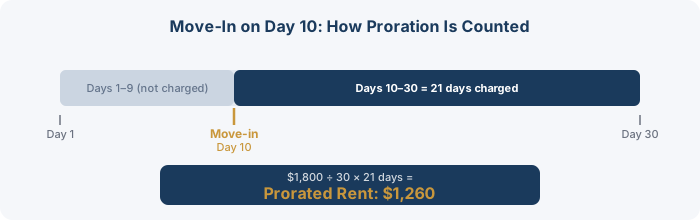
This is the most common situation. When you move in or out on any day other than the first of the month, the rent for that partial month gets prorated.
Say your monthly rent is $1,500 and you move in on the 20th of a 30-day month. You've got 11 days left in the month (counting the 20th). Your prorated rent:
($1,500 ÷ 30) × 11 = $550
Most U.S. landlords use a 30-day standard month as the denominator, regardless of the actual month length. Some use real calendar days. If you want to understand the difference, and when it matters, the 30-day vs. calendar month guide breaks it down with specific examples.
2. Salary
HR departments prorate pay when someone starts or leaves mid-pay-period. A monthly salary of $4,000 works out to $133.33/day on a 30-day basis. An employee who works 22 days in a given month earns:
$133.33 × 22 = $2,933.33
Annual salaries are sometimes calculated on a 365-day basis instead: $48,000/year ÷ 365 = $131.51/day. The method depends on the payroll system.
3. Subscriptions and Software Plans
When you upgrade or downgrade a software subscription mid-cycle, most services prorate the difference. If you're on a $20/month plan and upgrade to a $50/month plan on day 15 of a 30-day cycle:
- Days already on old plan: 15 × ($20 ÷ 30) = $10.00 already charged
- Days remaining on new plan: 15 × ($50 ÷ 30) = $25.00 owed
- Total for the month: $35
Compare that to $50 for a full month. The proration saves you $15 for the partial upgrade period.
4. Insurance Premiums
If you cancel a prepaid annual insurance policy before the term ends, the insurer refunds the unused portion, called the "unearned premium."
A $1,200/year policy cancelled after 90 days:
($1,200 ÷ 365) × 275 remaining days = $904.11 refund (before any cancellation fees)
This is why insurance policies have specific cancellation dates, the refund amount changes with every passing day.
Why Proration Matters
Without proration, billing is unfair in either direction. A tenant who moves in on the 29th would owe a full month's rent for two days of occupancy. A new employee starting mid-month would wait two weeks before receiving any pay, or receive a full period's pay for partial work.
Proration keeps charges proportional to use. It's a fairness mechanism built into payroll systems, accounting standards, and contract law. When a landlord, employer, or software company skips the proration and charges full price for a partial period, that's something you can dispute, because the standard practice is clear.
The Two Calculation Methods (for Monthly Charges)
For monthly billing, you'll encounter two approaches:
The 30-day standard: always divide by 30, regardless of the month. This is the default in most U.S. residential leases and most HR payroll systems. It's consistent: the same move-in date produces the same bill regardless of whether it falls in February or July.
Actual calendar days: divide by the real number of days that month has. More common in commercial leases and some European payroll systems. The daily rate changes month to month.
For annual charges, 365 is the standard divisor (366 if the period spans February 29th of a leap year).
The difference between methods is usually small, but for a February move-in it can mean $50–$100 on a typical lease. If your lease doesn't say which method your landlord uses, ask before signing.
What Proration Is Not
Proration is not rounding. A prorated amount is a precise calculation from the formula above. Rounding it to the nearest dollar is a separate step, and some billing disputes happen because one party rounds up and the other rounds down. The prorated amount itself is exact; the rounding is optional.
Proration is also not "half price for half a month." It's a daily calculation. Moving in on the 15th of a 30-day month means paying for 16 days (days 15 through 30, inclusive), not 15. If you think of it as dividing the month in half, you'll consistently undercount.
And proration isn't the same as a discount. It's not your landlord doing you a favor, it's the mathematically correct amount for partial use of a fixed-rate service.
When NOT to Use Proration
Not every partial-month charge gets prorated. Some contracts have minimum periods, flat activation fees, or "no partial month" clauses. Common examples:
- Short-term rentals that charge a flat nightly rate (already priced per night, no proration needed)
- Annual subscriptions that don't offer partial-year refunds
- Utility connection fees that are flat regardless of when in the month you connect
- Lease break penalties, which are usually a flat amount rather than a prorated remainder
If you're not sure whether a partial-period charge should be prorated, check the contract language. Look for phrases like "prorated," "partial period," "daily rate," or "upon cancellation." If the contract is silent, it's worth asking, prorated is the default in most billing contexts.
How to Calculate It Yourself
Three steps:
- Divide the full period charge by the total days in the period
- Multiply by the days you're actually using
- Round to two decimal places
Or skip the math entirely, estimate your prorated amount here. Enter the full charge, the total days in the period, and the days you used. It shows you the daily rate and the total in one step.
For more specific situations, see common proration mistakes tenants make before you pay a prorated bill, and how to split utilities when moving mid-month if you're dealing with more than just rent.
About our methodology, this site exists because proration is simple in theory but surprisingly easy to get wrong in practice. The calculator is designed to show every step so you can verify the math, not just trust the result.