30-Day Month vs. Calendar Month: Which to Use for Proration
Two landlords can charge different amounts for the same move-in date. Here's why, and how to know which method your lease uses.
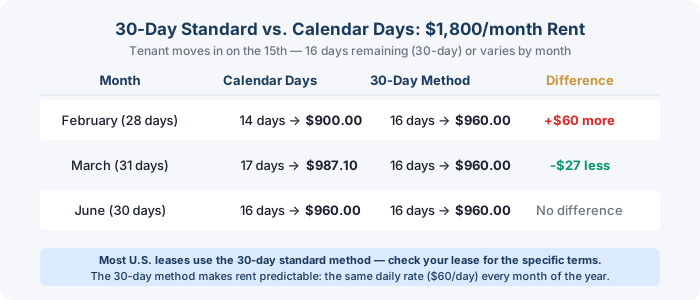
Quick Answer: Most landlords use a 30-day standard month for proration, dividing rent by 30 regardless of the actual month length. Some use actual calendar days. The difference can be $20–$50 on a typical lease, and in February, it's even more significant.
When you move in on the 15th, your landlord has to charge you for part of the month. Simple enough. But "part of the month" isn't calculated the same way everywhere. There are two common methods, and they can produce meaningfully different numbers depending on which month you move in.
The Two Methods, Explained
Method 1: The 30-Day Standard
Here, your landlord pretends every month has exactly 30 days. Your daily rate is always rent ÷ 30, no matter what.
So if your rent is $1,500 and you move in on the 18th of any month, you'd owe:
($1,500 ÷ 30) × 13 days = $650
That 13 comes from counting the 18th through the 30th, 13 days remaining.
Method 2: Actual Calendar Days
Here, the daily rate changes every month based on how many days that month actually has. January gives you 31 days in the denominator. February gives you 28 (or 29). The formula is: (rent ÷ days in that month) × days you occupied the unit.
Same $1,500 rent, move-in on the 18th:
- In July (31 days): ($1,500 ÷ 31) × 14 = $677.42
- In February (28 days): ($1,500 ÷ 28) × 11 = $589.29
Notice how moving into the same apartment on the same day of different months changes your bill by nearly $90. That's the real-world impact of this distinction.
Why Most Landlords Default to 30 Days
The 30-day standard is simpler, and simplicity matters when you're managing multiple units. You don't need to check a calendar. You don't need to remember whether a year is a leap year. The daily rate is always the same number, which makes conversations with tenants easier to have.
It's also the method baked into most property management software, so if your landlord is using Buildium, AppFolio, or a similar platform, there's a good chance you're being prorated on a 30-day basis without anyone explicitly deciding that.
The 30-day method also tends to be slightly more consistent and predictable for tenants. Your daily rate doesn't change based on the luck of the calendar.
When Calendar Days Apply
Calendar-day proration is more common in a few specific situations:
- Commercial leases, where precision is expected in the contract
- Short-term rentals and vacation rentals, where every day is explicitly priced
- States or jurisdictions where landlord-tenant statutes reference actual days
- Landlords who do their own math rather than using software
Some landlords also use calendar days because it feels more "accurate", and for months like July and August, they're right that it reflects real time more faithfully.
How February Changes Everything
February is the month where this difference becomes impossible to ignore. It only has 28 days (29 in a leap year), which makes the daily rate under the calendar method noticeably higher than under the 30-day standard.
Say your rent is $1,800 and you move in on February 5th. You're occupying the unit for 24 days.
- 30-day method: ($1,800 ÷ 30) × 24 = $1,440
- Calendar method: ($1,800 ÷ 28) × 24 = $1,542.86
That's a $102 difference. Same apartment. Same move-in date. Just a different formula.
For February move-ins, the calendar method costs you more as a tenant. The 30-day standard is cheaper. If you have any say in the matter, or if your lease doesn't specify, it's worth asking which method your landlord uses.
Which Method Favors Tenants?
It depends on the month:
| Month | Days | Better for Tenants |
|---|---|---|
| January | 31 | 30-day standard |
| February | 28/29 | 30-day standard |
| March | 31 | 30-day standard |
| April | 30 | Same either way |
| May | 31 | 30-day standard |
| June | 30 | Same either way |
| July | 31 | 30-day standard |
| August | 31 | 30-day standard |
| September | 30 | Same either way |
| October | 31 | 30-day standard |
| November | 30 | Same either way |
| December | 31 | 30-day standard |
The 30-day standard favors tenants in 7 out of 12 months, any month with 31 days. The two methods produce identical results in months with exactly 30 days. Calendar-day proration is never cheaper than the 30-day standard for a tenant.
This isn't a conspiracy. It's just math. Months with 31 days divide into a smaller daily rate when you use 31 as the denominator versus 30.
How to Tell Which Method Your Lease Uses
Read your lease carefully. Look for language like:
- "Prorated rent shall be calculated on a 30-day basis" → 30-day standard
- "Prorated rent shall be calculated based on the actual days in the month" → calendar method
- "Daily rate equals monthly rent divided by thirty" → 30-day standard
If your lease says nothing about proration method, ask your landlord in writing before you sign. Email is fine. Something like: "Can you confirm how you'll calculate my prorated first month's rent, do you use 30 days as the divisor, or the actual days in the move-in month?"
If they can't answer that question, use our prorate calculator to run both versions yourself so you know what to expect.
A Quick Comparison on the Same Scenario
Let's say rent is $2,000 and you're moving in on the 20th. Here's how the methods compare across different months:
- February move-in:
- 30-day: ($2,000 ÷ 30) × 9 = $600
- Calendar: ($2,000 ÷ 28) × 9 = $642.86
- June move-in:
- 30-day: ($2,000 ÷ 30) × 10 = $666.67
- Calendar: ($2,000 ÷ 30) × 10 = $666.67 (same, June has 30 days)
- August move-in:
- 30-day: ($2,000 ÷ 30) × 11 = $733.33
- Calendar: ($2,000 ÷ 31) × 12 = $774.19
That August example needs a note. When you move in on the 20th of a 31-day month, you occupy days 20–31, which is 12 days under the calendar method (counting the move-in day). Under the 30-day method, you'd count days 20–30, which is 11 days. So the "days used" number itself can differ between methods. Make sure you and your landlord agree on both the denominator *and* how to count the days you're being charged for.
You can estimate your prorated rent under both methods in about 10 seconds if you have your move-in date and monthly rent handy.
The Bottom Line
Neither method is "wrong." Both are in common use, and both are generally legal. What matters is consistency and transparency. Your lease should state which method applies, and your landlord should be able to show their math.
If you're comparing apartments and both are asking you to move in mid-month, you can use the actual calculation to compare true first-month costs, not just headline rent. A $1,600/month apartment with a February 10th move-in using the calendar method could cost you more in month one than a $1,650/month apartment with a 30-day standard proration.
See also: how landlords document prorated rent in leases and common mistakes tenants make when calculating proration, both worth reading before you sign anything.
If you want to see the exact math for your situation, our team built this calculator specifically to handle both methods side by side.