5 Common Proration Mistakes Tenants Make (and How to Avoid Them)
From miscounting move-in days to accepting the wrong method, these tenant proration mistakes cost real money. Here's what to watch for before you pay.
Quick Answer: The most common proration mistakes are not counting the move-in day itself, paying without checking the math, and not knowing whether your landlord uses a 30-day or calendar-month calculation. Each mistake can cost you $30–$100 on a single bill.
Moving into a new apartment mid-month should be straightforward. But when the landlord sends a prorated rent figure, many tenants just pay it without checking, and sometimes that's a mistake. Landlords aren't always trying to overcharge you; often they're using a different calculation method than you expected, or they made an arithmetic error. Here are five specific mistakes that come up regularly.
Mistake #1: Not Counting Your Move-In Day
This catches almost everyone the first time. If you move in on the 10th of the month, you might naturally count from the 11th, but most landlords charge starting on the 10th, the day you first had access to the unit.
Why it happens: It's intuitive to think of "days remaining" as the days after you move in. But in standard U.S. lease practice, day one of occupancy is the day you get the keys.
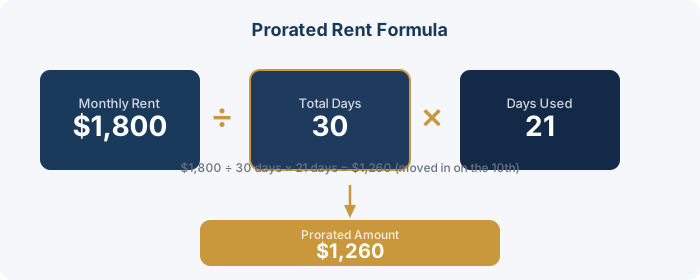
The financial impact: Moving in on the 10th of a 30-day month at $1,800/month. Your daily rate is $60.
- Counting from the 11th: 20 days × $60 = $1,200
- Counting from the 10th: 21 days × $60 = $1,260
That's a $60 discrepancy on a single month's bill. If your landlord is counting the move-in day and you're not, you'll think they've overcharged you, and the resulting conversation is awkward when both of you are actually right about your own math.
Fix: Ask your landlord explicitly before signing: "Do you count the move-in date as the first day of occupancy?" Get the answer in writing. Then use the same count when you verify their calculation with our prorate calculator.
Mistake #2: Paying Without Running the Math
Tenants often accept whatever number their landlord puts in the welcome email. Some landlords calculate it correctly; others round incorrectly, use the wrong day count, or make simple arithmetic errors.
Why it happens: People assume their landlord knows the formula and did it right. Usually they did. But "usually" isn't the same as "always."
The financial impact: A tenant paid $1,050 for a "prorated" first month on an $1,800/month apartment. The landlord said it was "a bit over half a month." When the tenant finally ran the numbers, 17 days remaining in the month at $60/day = $1,020, they'd overpaid by $30.
Thirty dollars isn't life-changing. But it tells you something about how that landlord will handle numbers going forward. And it takes less than a minute to verify.
Fix: Calculate the prorated amount yourself before paying. Formula: (monthly rent ÷ 30) × days used. If your landlord uses calendar days instead of 30, check our 30-day vs. calendar month guide to know which applies to you. Either way, run the numbers here, enter rent, choose monthly, enter your days.
Mistake #3: Not Knowing Which Day-Count Method Your Landlord Uses
There are two main methods for prorating monthly rent: the 30-day standard (always divide by 30) and the actual calendar days method (divide by the real days in that month: 28, 29, 30, or 31).
For most months, the difference is small. For February, especially a non-leap year, it's significant.
Why it happens: Tenants don't know there are two methods, so they assume their landlord is using the same one they are. When the numbers don't match, both parties think the other made an error.
The financial impact: $1,800/month rent, moving in on February 15th of a standard 28-day year, with 14 days remaining.
- 30-day method: $1,800 ÷ 30 × 14 = $840
- Calendar method: $1,800 ÷ 28 × 14 = $900
That's a $60 difference, and in this case, the 30-day method benefits you as the tenant. In July (31 days), the calendar method would benefit you instead.
Fix: Check your lease. If it says "prorated based on a 30-day month," use 30. If it says "based on actual days in the month," use the calendar count. If it says nothing, ask before signing. The most common default in the U.S. is the 30-day standard. If your landlord can't explain which method they use, that's a red flag worth addressing before you hand over money.
Mistake #4: Not Getting the Prorated Amount in Writing
Verbal agreements about prorated rent, even from a friendly landlord, are almost impossible to enforce if there's a dispute later. If your landlord tells you over the phone that your first month is $920 and you pay that, but the lease says rent starts on the 1st, you may have no way to prove the conversation happened.
Why it happens: Move-ins are hectic. You're coordinating movers, utilities, keys, and a hundred other things. A quick phone call seems easier than a paper trail.
The financial impact: A tenant was told verbally that first-month prorated rent was $850. They paid it. Two months later, the landlord claimed the tenant still owed $100 from the first month and sent a demand letter. The tenant had a payment receipt showing they paid $850, but nothing showing that $850 was the agreed prorated amount.
Fix: Before paying any prorated amount, ask for the calculation in writing. Email is fine. The message should include the move-in date, the calculation method, the daily rate, the number of days charged, and the total. Take 30 seconds to estimate your prorated amount and verify it matches what you've been sent.
Mistake #5: Confusing Prorated Rent with the Security Deposit
Some landlords ask for prorated first-month rent plus a full security deposit at signing. Others ask for first and last month's rent, where the "last month" deposit will also need to be prorated when you move out mid-month. It's easy to blur these categories and either overpay at move-in or be blindsided at move-out.
Why it happens: Leases use inconsistent language. "First, last, and security" sounds like three equal payments, but in practice each is calculated differently. And many tenants don't read the move-out clause until they're about to leave.
The financial impact: A tenant's lease said "first month, last month, and security deposit." They calculated their prorated first month at $900 and assumed the last month was also prorated, so they paid $900 for last month as well. But the landlord expected a full last-month deposit of $1,800, because the prorating happens at move-out, not move-in. The tenant was short by $900 at signing and almost lost the unit.
At move-out, the math goes the other way: if you paid a full last-month deposit and you leave on the 20th, your landlord owes you a partial refund. ($1,800 ÷ 30) × 10 remaining days = $600 back.
Fix: Read the lease clause about move-out carefully, specifically, what happens to the last-month deposit. If you need to prorate your final month, use the calculator to figure out what you actually owe, and document the expected return amount before your final walkthrough.
Quick Checklist Before Paying Prorated Rent
- Did you calculate it yourself using the formula (rent ÷ 30 × days, or rent ÷ calendar days × days)?
- Does your number match your landlord's?
- Do you know which day-count method they used?
- Are you counting your move-in day?
- Do you have the agreed amount confirmed in writing?
If yes to all five, you're in good shape. If not, run the numbers with our calculator and have the conversation before you write a check.
For a deeper look at the two proration methods and which one your lease likely uses, see 30-day month vs. calendar month proration. And if you're a landlord reading this, our landlord's guide to prorated rent covers the documentation and compliance side from your perspective.
Our team put this site together specifically to make these calculations easy to verify, because the math shouldn't be the thing that turns a routine move into a dispute.