Calculating Your Last Month's Prorated Rent
Moving out before month's end? Here's how landlords calculate your last month's prorated rent, how your security deposit fits in, and how to get the number in writing.
Quick Answer: Your last month's prorated rent is (monthly rent ÷ days in the month) × days you'll occupy the unit. If you're leaving May 20th and rent is $1,500, that's (1,500 ÷ 31) × 20 = $967.74.
Moving out mid-month should mean paying for the days you were actually there, not a full month. But getting the right number from your landlord, in writing, before you hand over your keys is what separates a smooth move-out from a dispute that drags on for weeks.
Here's how to handle it.
The Basic Calculation
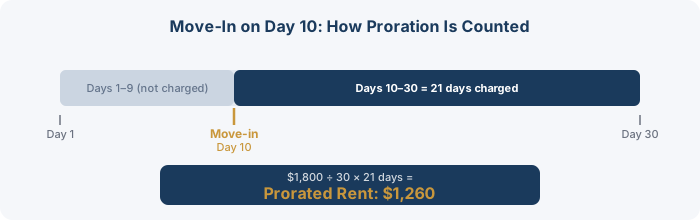
The formula is the same one used for move-ins, just applied to your final days of occupancy.
(Monthly Rent ÷ Days in the Month) × Days You're Occupying the Unit
Let's say your lease runs through May 20th. Rent is $1,500/month. May has 31 days.
(1,500 ÷ 31) × 20 = $967.74
That's what you owe for May. Not $1,500. Not some made-up "partial month fee." Just $967.74.
Now if that same scenario happened in April (30 days) instead:
(1,500 ÷ 30) × 20 = $1,000.00
A slightly different answer because April has fewer days. The month you move out in changes the denominator, so always do the math specific to that month.
Does Your Move-Out Day Count?
This is the one that creates the most arguments. Does the day you hand over your keys count as a day of occupancy?
In most cases, yes, your move-out day is included. You still had legal access to the unit on that day, even if you returned the keys at 10am. The practical test: did your landlord have the ability to show the unit to a new tenant that morning? Probably not, because you were still there.
That said, some leases specify "occupancy ends at noon on the final day" or similar language. Read yours. If it's silent on this, default to counting the move-out day.
How Your Security Deposit Fits In
Your security deposit is not last month's rent, unless your lease explicitly says it is.
Some leases say "first and last month's rent collected upfront," and in that case your last month's deposit was already paid when you moved in. If that's your situation, you may owe prorated rent minus what's already been collected, or you may be owed a refund.
Example: You paid $1,500 as last month's deposit. You're moving out May 20th and the prorated amount is $967.74. You're owed a refund of $532.26 from that deposit, assuming no damages.
Most security deposits, however, aren't designated as last month's rent. They're held for damages and other charges. Don't assume your deposit covers last month's rent unless your lease says so. Withholding rent because "my deposit will cover it" is a fast track to legal trouble with most landlords.
Your Notice Period and How It Affects the Calculation
Most leases require 30 days' notice before move-out. Some require 60. If you're on a month-to-month agreement, check your state's laws, many require at least 30 days regardless of what the lease says.
Here's where notice affects your costs: if you give notice that you're leaving May 20th, but your lease requires 30 days' notice and you only gave 25 days, your landlord may charge you through the end of the required notice period rather than your actual move-out date.
That might mean you owe rent through May 25th even if you've already left. Some landlords will waive the extra days if they can re-rent quickly, but they're not obligated to.
Give proper notice. Put it in writing. And give it early.
Getting the Amount in Writing
Before your last month begins, send your landlord a message (email is fine) with your planned move-out date and ask them to confirm the prorated amount.
Something like: "My move-out date is May 20th. Based on 20 days of occupancy in a 31-day month at $1,500/month, I calculate my May rent as $967.74. Please confirm this is correct before I set up payment."
That email does two things: it shows you've done the math, and it creates a record if there's a dispute later.
If your landlord comes back with a different number, ask them to show their calculation. Don't just pay the higher amount because they insist.
Use our prorate calculator to run the numbers first, then include the result in your message. It's harder to argue with someone who shows their work.
What If Your Landlord Wants a Full Month?
This happens. Some landlords, especially smaller private landlords, simply charge full month's rent regardless of when you leave. Whether that's legal depends on your lease and your state.
If your lease says "tenant owes rent through the lease termination date" and your termination date is May 20th, you should only owe through May 20th. Full stop.
If your lease says "rent is due for the full final month," that's a different clause, and you may have agreed to it when you signed. Read your lease before pushing back.
If you're in a state with strong tenant protections, you may have additional rights here. A quick check with your local tenant rights organization can clarify what applies to your situation.
When the Math Involves Mid-Month Last Day
If you're leaving on the last day of the month, there's no proration needed, you owe a full month. The math only changes when you're vacating before the month ends.
Leaving May 31st? Pay $1,500. Leaving May 30th? Pay (1,500 ÷ 31) × 30 = $1,451.61. It's almost a full month, but not quite, and you shouldn't pay full rent for a day you weren't there.
For context on how the same formula applies when you moved in, see our post on prorated rent for your first month, the logic is identical, just applied to the beginning of your tenancy instead of the end.
And for a complete walkthrough of the formula with multiple examples, our guide on how to calculate prorated rent covers all the variations you're likely to encounter.
The team behind this site has seen how often move-out billing goes sideways, usually from simple math errors, not bad intent. Knowing the formula and asking for written confirmation before you pay is the best protection you have.
Move out clean, pay what you actually owe, and get everything confirmed in writing. That's the whole playbook.