How to Calculate Prorated Rent (With Examples)
Learn the exact formula for prorated rent, see two worked examples, and find out how to verify your landlord's math before you sign anything.
Quick Answer: Divide your monthly rent by the number of days in the month, then multiply by the days you're actually occupying the unit. That's your prorated rent, nothing more complicated than that.
Prorated rent comes up whenever you move in or out on a day that isn't the first of the month. Landlords calculate it differently, some use calendar days, some use a flat 30-day month, and that difference can cost you real money if you're not paying attention.
Here's how to do the math yourself, check your landlord's work, and know when something doesn't add up.
The Formula
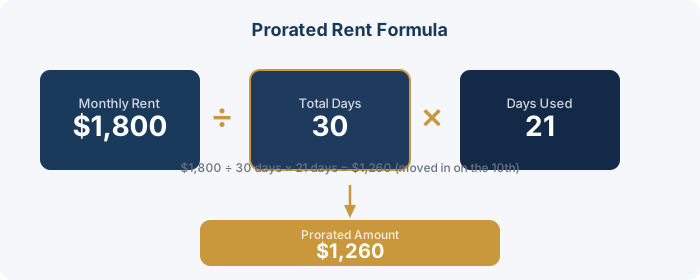
The core calculation is simple:
(Monthly Rent ÷ Total Days in Month) × Days You're Occupying the Unit
That's it. The tricky part is agreeing on what "total days" means, more on that in a moment.
Example 1: Moving In Mid-Month
Say you're moving into a new apartment on April 15th. Rent is $1,800/month. April has 30 days.
You'll occupy the unit for 16 days in April (the 15th through the 30th, and yes, your move-in day counts).
(1,800 ÷ 30) × 16 = $960
Your first month's rent should be $960. If your landlord asks for anything significantly different, ask them to walk you through their math. Use our prorate calculator to double-check before the conversation.
Example 2: Moving Out Before Month's End
Now picture the opposite scenario. You're leaving on May 20th. Rent is $1,500/month. May has 31 days.
You occupied the unit for 20 days.
(1,500 ÷ 31) × 20 = $967.74
Round it to $967.74 or $968, your landlord may round differently, but it shouldn't differ by more than a dollar or two.
Calendar Days vs. the 30-Day Method
Here's where landlords diverge. There are two common approaches:
Calendar days: Use the actual number of days in that specific month, 28, 29, 30, or 31. This is the most accurate method and the one most tenants prefer because the math is transparent.
30-day method: Always divide by 30, regardless of the actual month. It simplifies the math but can hurt you. Moving into a unit on April 15th using the 30-day method gives you $1,800 ÷ 30 × 16 = $960, same answer in this case. But move in on January 15th with 17 days remaining: calendar method gives you $1,800 ÷ 31 × 17 = $987.10, while the 30-day method gives $1,800 ÷ 30 × 17 = $1,020. That's a $33 difference in one month.
Neither method is universally illegal, but the calendar-day method is fairer and more common. Ask your landlord which they use before move-in day.
Does the Move-In Day Count?
Almost always yes. If you have keys and access to the unit on April 15th, you're paying for April 15th. Some leases say occupancy begins at noon on move-in day, that's fine, but it doesn't change the day count for proration purposes.
If your landlord tries to charge you starting April 14th because "we gave you access the evening before to move boxes," push back on that in writing.
How to Verify Your Landlord's Calculation
When you get a move-in cost sheet, do three things:
- Confirm the monthly rent matches your lease
- Ask which proration method they used (calendar days or 30-day)
- Plug the numbers into our prorate calculator yourself and compare
If the numbers match, great. If they're off by more than $1-2 (rounding), ask for a written explanation before paying.
What If You Move In on the 1st?
No proration needed, you pay a full month's rent. The calculation only applies when your lease starts or ends mid-month.
Some tenants try to negotiate a partial month when starting on the 1st if the previous tenant just vacated. That's a lease negotiation, not a proration issue, and landlords aren't obligated to do it.
What If You Move In on the Last Day of the Month?
This is where things get interesting. If you move in on April 30th, you're occupying the unit for one day in April.
(1,800 ÷ 30) × 1 = $60
Your April rent is $60. Then your full May rent of $1,800 is due May 1st. That's not a trick, it's just how the math works. Some landlords will let you skip the prorated April payment and just start your lease May 1st instead. Either approach is legitimate; get whatever you agree to in writing.
Common Mistakes to Watch For
Landlord uses 30-day method but doesn't disclose it. This is the most common issue. In months with 31 days, using 30 as the denominator increases your rent slightly. It's not necessarily illegal but it should be disclosed.
Counting days wrong. A landlord might accidentally count April 15th through April 30th as 15 days instead of 16. Count it yourself: April 15, 16, 17... 30. That's 16 days.
Charging a full month when you moved out early. If your lease ended mid-month and the landlord is charging full rent, they need to provide a written calculation. You shouldn't pay for days you weren't there, assuming your lease agreement allows early-month termination.
For any of these situations, estimate your prorated rent first so you walk into the conversation with the correct number already in hand.
A Note on Leases
Your lease should specify the proration method. If it doesn't, ask for an addendum before signing. A sentence like "Prorated rent will be calculated using the actual number of days in the month" protects you from the 30-day method being applied silently.
If you want to understand more about how we approach these calculations, visit our team's page, we've been building tools for tenants and landlords since this kind of calculation confusion first became a common complaint.
Prorated rent isn't complicated math. It's just division and multiplication. Once you know the formula, you're never at the mercy of someone else's spreadsheet.