Prorated Rent for Your First Month: What to Expect
Moving in mid-month? Here's exactly how your first month's prorated rent is calculated, what to watch for, and how to spot errors in the landlord's math.
Quick Answer: Your first month's prorated rent equals your monthly rent divided by the number of days in that month, multiplied by the days you'll actually be there. Move in April 15th at $1,500/month? That's (1,500 ÷ 30) × 16 = $800.
Prorated rent for your first month is one of the first financial interactions you'll have with a new landlord. Getting it right matters, not just for the money, but because it sets the tone for how you'll handle disputes going forward.
Let's walk through exactly how it works, day by day.
How to Count Your Days
The most common confusion is simple: how many days am I actually paying for?
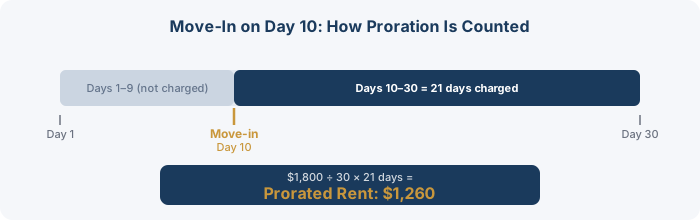
Your move-in day counts as day one. If you get keys on April 15th, you're paying for April 15th. Count forward to April 30th and you've got 16 days, not 15, because you include both endpoints.
An easy way to check: subtract the move-in date from the last day of the month, then add 1.
April 30 − April 15 = 15, then +1 = 16 days
That "+1" trips people up constantly. A landlord who miscounts and charges you for 15 days instead of 16 is actually undercharging you (lucky you), but a landlord who charges for 17 days owes you an explanation.
Moving In on the 1st
No proration happens. You pay a full month. Simple.
If you're moving in on April 1st and the previous tenant left March 31st, you don't get a discount just because the unit sat empty for a day. Proration is about your occupancy, not the unit's vacancy.
Moving In on the 15th
This is probably the most common scenario. Mid-month move-ins happen all the time when leases overlap or you're coming from another city and need a few weeks to get organized.
Here's the math for April 15th at $1,800/month:
(1,800 ÷ 30) × 16 = $960
You'd owe $960 for April, then $1,800 starting May 1st. Use our prorate calculator to confirm this before you hand over a check.
Now, what if you're moving in on January 15th at the same rent? January has 31 days, and you'd occupy it for 17 days (Jan 15 through Jan 31).
(1,800 ÷ 31) × 17 = $987.10
That's $27 more than the April scenario, simply because January has 31 days. This is why the month matters.
Moving In on the Last Day of the Month
Moving in on April 30th means you're occupying the unit for exactly one day in April.
(1,800 ÷ 30) × 1 = $60
Sixty dollars. Then full rent on May 1st. It might feel weird to write a check for $60 before paying $1,800 the next day, and some landlords will just waive it and start your lease May 1st. Either approach is fine, just make sure your lease reflects whatever you agreed to.
When Does the Landlord Count the Move-In Day?
Almost every landlord counts the move-in day. It would be unusual not to.
Where it gets murkier: some landlords distinguish between the date you signed for keys and the date your lease officially begins. If you got early access for storage on April 14th but your lease says April 15th, you should only be paying from April 15th.
Watch the lease start date carefully. If the landlord is charging you from a date earlier than what your lease says, that's a billing error, or worse.
Red Flags in Your Landlord's Math
The numbers don't match any standard method. If your landlord can't explain whether they used calendar days or a 30-day month, that's a problem. There should be a clear formula, and they should be able to show it to you.
They're charging a "partial month fee" on top of prorated rent. Some landlords try to add an administrative fee for mid-month move-ins. This isn't standard, it's not legally required in most states, and you should push back on it in writing.
The prorated amount is higher than a full month. This sounds absurd, but it happens when a landlord accidentally uses the wrong denominator, say, dividing by 28 days in a month that has 30. Double-check their denominator.
They want to charge first, last, and prorated. First and last month's deposit plus prorated rent is a lot of money upfront. Make sure you understand which is a deposit (refundable) and which is rent (not refundable). Those are very different things.
Getting It in Writing Before Move-In
Before you pay anything, ask for a written move-in cost breakdown. It should show:
- Monthly rent amount
- Move-in date
- Number of days being charged
- Calculation method (calendar days or 30-day)
- Total prorated amount
If your landlord is professional, this takes them five minutes to produce. If they're resistant to writing it down, that tells you something.
Estimate your prorated rent with your actual dates first, then compare it to what your landlord sends you. If the numbers are close (within $1-2 for rounding), you're good. If they're off by $50, you need to have a conversation before move-in day.
What Happens If You Move In Early Without Permission
Sometimes tenants get access to the unit before their official lease start date, maybe to paint, or because the landlord is being accommodating. That's nice of them.
But if they later try to charge you rent for those extra days, that's only fair if you agreed to it upfront. Verbal agreements here are risky. If you're getting early access, send an email confirmation: "Thanks for letting me access the unit on April 12th for painting, I understand my lease and rent obligations still begin April 15th."
That paper trail protects you.
For more detail on how proration works across different scenarios, read our guide on how to calculate prorated rent, it covers the formula, calendar days vs. 30-day method, and verification steps.
If you want to understand who builds these tools and why, take a look at who we are.
Your first month's rent calculation shouldn't be a mystery. Know the formula, count the days carefully, and don't pay anything you can't verify.