Landlord's Guide to Prorated Rent: Rules and Best Practices
How to calculate, document, and collect prorated rent the right way, including the mistakes that lead to disputes and what the law actually requires.
Quick Answer: Most states don't mandate a specific proration formula, but you're generally required to charge only for the days a tenant actually occupies the unit. Use a written addendum, show your math, and collect prorated rent separately from the first full month.
Prorated rent is one of those things that feels straightforward until you're standing in front of a tenant who disputes your number. Here's what you need to know to handle it cleanly, from the formula to the paperwork.
What the Law Actually Says
The Uniform Residential Landlord and Tenant Act (URLTA), which has been adopted in full or in part by over a dozen states including Arizona, Florida, and Iowa, doesn't specify a proration formula. What it does say, in essence, is that landlords can't charge rent for periods the tenant doesn't occupy the unit.
In practice, that means:
- You can't charge a full month's rent when the tenant moves in on the 15th
- You can't require a tenant to pay through the end of the month when they've given proper notice and vacate early
- The proration method you use should be applied consistently, and ideally stated in the lease
States like California, New York, and Texas have their own landlord-tenant statutes, but the underlying principle is the same: rent is owed for occupancy. If there's no occupancy, there's no rent owed.
The Standard Formula
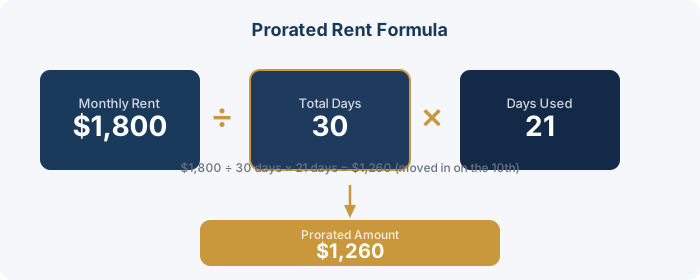
The formula almost every property manager uses:
(Monthly Rent ÷ Days in Billing Period) × Days Tenant Occupies Unit
The "days in billing period" is where landlords diverge. You can use 30 (the 30-day standard) or the actual days in the move-in month. Either is defensible, what matters is that you pick one and document it.
Example: Tenant moves in on March 19th. Monthly rent is $1,750.
Using 30-day standard:
- Days remaining in March from the 19th: 12 (the 19th through the 30th)
- ($1,750 ÷ 30) × 12 = $700.00
Using actual calendar days (March has 31 days):
- Days remaining: 13 (the 19th through the 31st)
- ($1,750 ÷ 31) × 13 = $734.68
Both are legitimate. Decide before the lease is signed, not after the tenant moves in and asks why their bill doesn't match what they expected.
Use our prorate calculator to verify your figures before sending them to a tenant, it takes less than a minute and gives you something to show your work.
First Month vs. Last Month: They're Different Problems
First month proration is the most common scenario. The tenant starts mid-month. You charge them for the days from move-in through the end of the month, then collect a full month's rent going forward.
A clean way to handle this: collect the prorated first month and the security deposit before move-in. Don't bundle the prorated rent into the first full month's payment, it creates confusion about what's rent and what's deposit.
Last month proration is trickier. If your lease ends on a date other than the last day of the month, or if a tenant gives notice that results in a mid-month departure, you'll need to prorate their final payment.
Here's where landlords get into trouble: collecting a "last month's rent" deposit at move-in and then also charging prorated rent for the final partial month. If the tenant paid a full month upfront as a last-month deposit, they shouldn't owe for the partial final month, they've already overpaid, and you owe them a refund of the difference.
Say last month's rent was $1,750 and the tenant vacates on the 20th. They occupied 20 days.
- Prorated last month: ($1,750 ÷ 30) × 20 = $1,166.67
- They prepaid $1,750
- You owe them $583.33 back
Not refunding that is one of the most common reasons landlords end up in small claims court.
Documenting Prorated Rent in Writing
Never handle proration verbally. You want a paper trail that shows:
- The move-in or move-out date
- The monthly rent amount
- The proration method used (30-day or calendar)
- The daily rate calculation
- The number of days being charged
- The total prorated amount due
The easiest approach is a one-page lease addendum titled "Prorated Rent Calculation" that both you and the tenant sign before move-in. It doesn't need to be complex. Something like:
*Tenant [Name] takes possession on [Date]. Monthly rent is $[amount]. Prorated rent for [Month] is calculated as follows: $[rent] ÷ [30 or actual days] × [days] = $[amount]. This amount is due at lease signing.*
Keep a copy. Send the tenant a copy. If there's ever a dispute, you have documentation with both signatures on it.
Common Landlord Mistakes
Mistake 1: Charging a full month when the tenant moves in after the 1st.
This is the most frequent error, and it's the one tenants are most likely to push back on, or file a complaint about. If your tenant moves in on the 10th, they don't owe rent for the 1st through the 9th. Period.
Mistake 2: Inconsistent proration methods.
Using the calendar method for one tenant and the 30-day standard for another in the same building is a fair housing risk. It looks like discrimination even if it isn't. Pick a method and apply it uniformly.
Mistake 3: Not accounting for the security deposit separately.
Prorated rent and security deposit are different things. Don't blur them together in the same line item on a move-in statement. Auditors, courts, and tenants all want to see these separated clearly.
Mistake 4: Forgetting to prorate when a tenant gives proper notice mid-month.
If a tenant gives 30 days notice on the 15th and vacates on the following 15th, their final month is prorated from the 1st to the 15th. You can't charge them for the full month because they gave notice mid-month.
Mistake 5: Charging prorated rent for the last month when a last-month deposit was collected.
Covered above, but worth repeating because it's expensive when it goes to court.
What to Put in the Lease
Your lease should spell out:
- The proration method (30-day standard or actual calendar days)
- Whether move-in day counts as day one of occupancy
- How the last month is handled if the tenancy ends mid-month
- The daily rate formula (so the tenant can verify your math)
Most standard lease templates from your state's apartment association will have a proration clause. Read it before you use it, some are outdated or vague. If it's vague, add a brief addendum that clarifies the specifics.
A Note on Property Management Software
If you're using property management software, check what proration method it defaults to. AppFolio, for instance, uses calendar days by default. Buildium defaults to a 365-day annual basis, dividing annual rent by 365, then multiplying by days. That third method produces slightly different numbers than either the 30-day or calendar approach. If your lease says one thing and your software does another, you've got a discrepancy that a sharp tenant will notice.
Run your software's proration output through a manual check, or use the calculator here to verify the figure, before sending a tenant their first invoice.
Best Practices Summary
- Decide on a proration method before signing any lease
- Document the calculation in a signed addendum
- Collect prorated rent and security deposit separately
- Apply the same method to every tenant in the building
- When a tenant leaves mid-month, recalculate and refund the difference if a last-month deposit was held
- Check your software's default proration method and verify it matches your lease language
The details of how different proration methods compare are worth reading if you want to understand why the 30-day standard became the default for most landlords. And if your tenants are asking questions about their bills, pointing them to what is proration and how it works can save you a lot of back-and-forth.
Who we are, we've worked through thousands of these calculations, and if you're ever unsure whether your number is right, the calculator will show you the full math step by step.