Prorating Subscriptions: How Services Bill Partial Months
Learn how subscription services calculate prorated charges when you upgrade, downgrade, or cancel, and how to verify the refund or credit you're owed.
Quick Answer: Subscription proration divides your plan cost by the billing period length, then multiplies by the days remaining (for upgrades) or days unused (for refunds). A $120/year plan cancelled after 90 days: $120 ÷ 365 × 275 = $90.41 remaining value.
Prorated subscription billing affects you every time you change plans mid-cycle, cancel before a renewal, or upgrade to a higher tier. Services handle it differently, some credit you instantly, some round down to the nearest day, some use 30 days regardless of the actual month. Knowing how the math works means you can tell when a refund is short.
How Subscription Proration Works
The principle is the same as rent proration: you pay for what you use.
(Plan Cost ÷ Total Days in Billing Period) × Days Used or Remaining
Where it gets complicated is the billing period. Monthly plans often use 30 days as a flat denominator. Annual plans typically use 365. And some services use 30.44 days (365 ÷ 12) for monthly calculations on annual contracts. You'll see all three in the wild.
Annual vs. Monthly: The Denominator Problem
This distinction matters more than people realize.
Annual plan proration uses 365 days. If you paid $120/year upfront and cancel after 3 months (90 days), the unused portion is:
(120 ÷ 365) × (365 − 90) = (120 ÷ 365) × 275 = $90.41
You'd expect a refund of about $90.41. Whether you actually get that depends on whether the service issues refunds at all, many don't, they just credit your account.
Monthly plan proration uses 30 days (usually). If you're on a $20/month plan and upgrade on day 12, the service calculates what you paid for the remaining 18 days of your current cycle:
(20 ÷ 30) × 18 = $12.00
That $12 becomes a credit toward your new plan price. Most SaaS platforms do this automatically when you upgrade.
Use our prorate calculator to check the math before accepting a service's credit or refund figure.
Worked Example: Upgrading a $120/Year Plan
Let's say you're on an annual plan at $120/year ($10/month equivalent). You paid January 1st. On April 15th, 104 days in, you decide to upgrade to the $240/year tier.
Step 1: Calculate your unused value on the old plan
Days remaining: 365 − 104 = 261 days
Unused value: (120 ÷ 365) × 261 = $85.81
Step 2: Calculate the prorated cost of the new plan for those same 261 days
New plan prorated: (240 ÷ 365) × 261 = $171.62
Step 3: What you owe on upgrade
$171.62 − $85.81 = $85.81
You'd pay $85.81 to upgrade, which covers the price difference for the remaining period. If the service charges you significantly more than this, it's worth asking for their calculation.
What About Downgrades?
Downgrades are where services tend to get creative. Many won't issue a cash refund, instead they credit your account and let the credit apply to future invoices.
If you downgrade from $240/year to $120/year on day 104, your unused value on the premium plan is:
(240 ÷ 365) × 261 = $171.62
But you'd only need (120 ÷ 365) × 261 = $85.81 for the remainder of the year on the cheaper plan. The difference, $85.81, should appear as account credit.
Whether that credit expires, whether it carries over on renewal, and whether you can get it refunded to your card are all policy questions. The math tells you what you're owed; the terms of service tell you what you'll actually get.
Cancellations: What Refund Are You Owed?
This depends entirely on whether the service offers refunds at all. Many SaaS companies have a "no refunds on annual plans" policy. That doesn't mean the prorated math is irrelevant, it tells you how much you're forfeiting by cancelling.
If refunds are available, the formula is:
(Plan Cost ÷ Days in Period) × Days Remaining
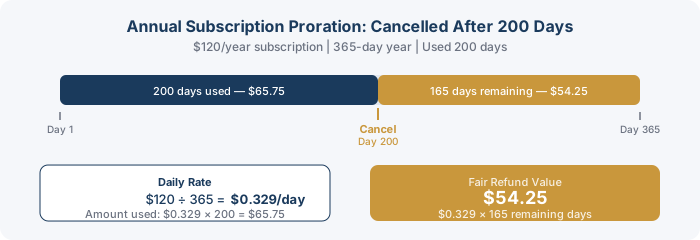
For a $120/year plan cancelled at day 200:
(120 ÷ 365) × 165 = $54.25 remaining value
If you're only offered $40, that's short by $14.25. It's worth a support ticket with the calculation attached.
For monthly plans, the refund window is shorter because the amounts are smaller, but the formula is the same. Cancelled on day 18 of a $20/month cycle:
(20 ÷ 30) × 12 = $8.00 remaining
Why Services Use Different Methods
30-day method: Simple and consistent. Doesn't favor customers in short months or penalize them in long ones. Common for B2C subscription apps.
Calendar-day method: More accurate. Used by services that care about precision, typically B2B SaaS where billing amounts are larger and customers will scrutinize the math.
30.44-day method (365 ÷ 12): A statistical average. Used by some platforms to normalize monthly billing across the year. You're unlikely to notice the difference unless you're running large-scale billing.
None of these is inherently wrong. What matters is whether the service applies its chosen method consistently.
When the Service's Math Seems Off
Here's a checklist for disputing a proration:
- Identify their method. Monthly plans usually use 30 days. Annual plans use 365. Check their help documentation.
- Count your days. From the date you paid or your last renewal, to the date you changed plans or cancelled.
- Run the calculation yourself. Estimate your prorated amount with your actual numbers.
- Compare. If their number is more than a dollar or two off, contact support with your calculation. Include: plan cost, billing date, change date, days used, and your calculated result.
Most billing teams will correct a genuine error quickly. Framing it as "here's my calculation, please confirm" rather than "you ripped me off" tends to move faster.
Free Trials and Prorated Billing
Free trials that convert to paid plans usually start your first billing cycle from the conversion date, so there's no partial period to prorate. But if a service converts you mid-cycle (say, your trial started the 10th and your billing cycle runs 1st to 1st), you may get charged a prorated amount for the remaining days of the current cycle. That's normal and should be disclosed at sign-up.
If you weren't told about a prorated charge at conversion, it's worth disputing with the service, not because the math is wrong, but because you weren't given the information to make an informed decision.
For more on proration fundamentals, the guide on how to calculate prorated rent covers the same formula applied to housing, useful if you're new to the concept.
The team behind this site built these tools because proration math shouldn't be opaque. Whether it's rent, salary, or a SaaS subscription, the formula is the same, and you deserve to be able to check it yourself.