How to Prorate a Salary for a Partial Pay Period
HR guide to prorating salary for new hires and departing employees. Includes the formula, calendar vs. working days methods, and worked examples.
Quick Answer: Divide the employee's salary for the pay period by the total days (or working days) in that period, then multiply by the days they actually worked. A $5,000 semi-monthly salary with 10 of 11 working days worked = $5,000 ÷ 11 × 10 = $4,545.45.
Prorating salary comes up every time someone starts or leaves mid-pay-period. It's one of those calculations that sounds simple but trips up HR teams and payroll software alike, mostly because there are two different methods and people don't always agree on which one applies.
Here's how to do it correctly, whether you're running monthly payroll or bi-weekly.
The Formula
The base formula is the same as any proration calculation:
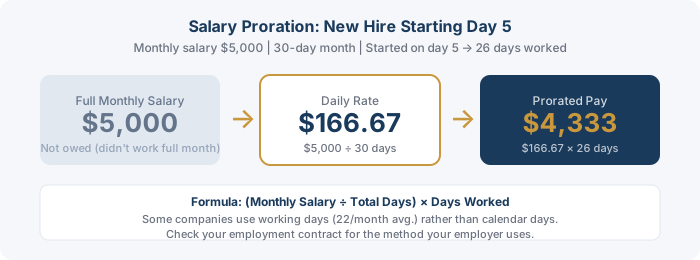
(Salary for Period ÷ Total Days in Period) × Days Worked
The only real debate is what counts as a "day." You can use calendar days or working days. Both are common. Both are defensible. They produce different numbers, and you need to decide upfront which method your company uses, and apply it consistently.
Method 1: Calendar Days
Calendar-day proration uses every day in the pay period as the denominator, including weekends and holidays.
Example: New hire starting January 15th, monthly payroll
Annual salary: $72,000. Monthly salary: $6,000. January has 31 days.
The employee works from January 15th through January 31st, that's 17 calendar days.
(6,000 ÷ 31) × 17 = $3,290.32
This method is simple to explain and easy to audit. The downside: an employee starting on a Thursday gets a slightly different rate than one starting on a Monday, purely because of weekend placement.
Method 2: Working Days
Working-day proration uses only business days (Monday through Friday, excluding holidays) as the denominator. Many payroll teams prefer this because it feels more intuitively tied to actual work performed.
Same example using working days:
January 2026 has 22 working days. The employee works from January 15th (Thursday) through January 31st. Count the working days in that range: 15, 16, 20, 21, 22, 23, 27, 28, 29, 30 = 10 working days.
(6,000 ÷ 22) × 10 = $2,727.27
That's a significant difference from the calendar-day result, $563 less. The reason is that January has more non-working days relative to the employee's start date when measured this way.
Neither method is "wrong," but you need to apply the same method to every employee, every time. Mixing methods creates legal exposure and payroll inconsistencies that are hard to defend.
Use our prorate calculator to run both versions and compare before you finalize payroll.
Example: Employee Starting Mid-Month (Bi-Weekly Payroll)
Bi-weekly payroll runs every two weeks, 26 pay periods per year. Each pay period covers 14 calendar days.
Scenario: An employee with a $95,000 annual salary starts on a Wednesday, March 11th. The current pay period runs March 1–14.
Annual salary ÷ 26 = $3,653.85 per bi-weekly period
Using calendar days: 14 total days in the period, employee works March 11–14 = 4 calendar days.
(3,653.85 ÷ 14) × 4 = $1,044.53
Using working days: 10 working days in the period (March 1 is a Sunday, so working days are March 2–6 and March 9–13 = 10 days). Employee works March 11–13 = 3 working days.
(3,653.85 ÷ 10) × 3 = $1,096.15
Document which method you're using in your payroll policy. Employees will ask.
Example: Employee Leaving Mid-Period
The formula works the same way in reverse. Someone resigning mid-pay-period gets paid only for the days they actually worked.
Scenario: An employee earning $85,000/year on a semi-monthly schedule (24 pay periods, $3,541.67 per period) gives notice and their last day is April 10th. The April 1–15 pay period has 15 calendar days and 11 working days.
Calendar-day method:
(3,541.67 ÷ 15) × 10 = $2,361.11
Working-day method:
April 1–10 working days: April 1, 2, 3, 6, 7, 8, 9, 10 = 8 working days.
(3,541.67 ÷ 11) × 8 = $2,576.85
For departing employees, the working-day method often results in higher pay, which can feel more fair to the employee and reduces friction on exit. But again, consistency matters. Don't switch methods based on whether it favors the company or the employee.
Monthly vs. Bi-Weekly: Which Is Harder to Prorate?
Monthly payroll is simpler to prorate because you're working with a known, fixed salary amount for the month. The denominator is always the number of days (or working days) in that specific month.
Bi-weekly payroll requires you to first convert the annual salary to a per-period amount ($annual ÷ 26), then prorate within that 14-day window. One small step more, but the formula is the same.
Semi-monthly payroll (24 periods/year, always the 1st and 15th) is the trickiest because the periods don't align cleanly with calendar weeks. If someone starts on the 18th of a month, they're in the middle of the 15th–31st period, and that period has varying lengths depending on the month.
How to Handle Overtime and Bonuses
Proration applies to base salary. Overtime, commissions, and bonuses typically have their own calculation rules. Don't apply the salary proration formula to an overtime component, those are usually calculated on actual hours worked, which is already a partial-period calculation by nature.
Signing bonuses and performance bonuses may have partial-period language in offer letters. Read those clauses before assuming proration applies.
Documenting Your Method
Your payroll policy should state:
- Which proration method you use (calendar days or working days)
- How you handle the start and end days (do they count? always yes)
- How you handle holidays within a partial period
- How the calculation is done for each payroll frequency you run
This isn't just good HR practice, it protects you in wage and hour disputes. An employee who feels underpaid on their first check will ask questions. Having a written policy with the exact formula means you can answer in 60 seconds instead of a week-long back-and-forth.
For a fast sanity check on any of these scenarios, estimate your prorated salary before you run payroll. And if you want to understand the approach behind our tools, meet our team.
Salary proration is arithmetic. The hard part is picking a method and sticking with it.